.

ruminations on sports and other complexities of the universe

--from Eric and Adam
Showing posts with label Top-10. Show all posts

February 17, 2012

Tennis Top-10: #2 Margaret Court and #1 Steffi Graf

2) Margaret Court

Between both men and women, Margaret Court holds the most Grand Slam singles titles all-time with 24.  From 1969-1971 Court won 6 consecutive Grand Slam singles titles, a Calendar Slam-and-a-half.  A native Australian, Court owned her homeland Australian Open, winning it a record 11 times.  She claimed the French Open 5 times, the US Open 5 times, and Wimbledon 3 times.  Also a winner of what is called the “box set,” meaning to win the singles, doubles, and mixed doubles championships at every single grand slam, Court is one of three players in history to do so.

Overall combining singles, doubles, and mixed doubles Court claimed a flabbergasting 62 Grand Slam titles in her career, giving her not only the most accomplished career of any singles player ever, but the most combined Grand Slams of any player in history.

By any measure, Court was the most consistently and statistically proficient player of all-time. I simply feel she was never quite as purely dominant as my number one, nor did she play in as competitive of an era.

#2 Margaret Court
1) Steffi Graf

This is a unisex list, and at the top a woman reigns supreme.  Though Steffi Graf’s overall numbers may not be as aw- inspiring as Court’s, her sheer dominance over her career makes her the clear choice as the best tennis player of all time.

Graf claimed 22 grand slam singles titles—7 Wimbledons, 6 French Opens, 5 US Opens, and 4 Australians—from 1987-1999, doing most of her damage in a nine-year window from ‘87-‘96.  That Graf was equally brilliant on grass and clay, the two most drastically different surfaces in tennis, is proof of her versatility, immense talent, and extreme will to win.

In 1988 Graf won all four Grand Slam singles titles, plus the Olympic Gold Medal in singles—referred to as the Golden Slam—and is the only player man or woman to  ever have done so.  Perhaps the punctuation on her year of absolute brilliance in 1988 was her demolition of Natalia Zvereva: 6-0, 6-0 in the French Open Final.

From 1987-1990 Graf made thirteen-consecutive Grand Slam finals, again a mark that is unequaled by any man or woman in tennis history.  In terms of her career ranking, she holds the following records for both men and women: Most consecutive weeks ranked # 1 (186), most times finishing the year ranked #1 in the world (8), and most total weeks ranked #1 over her career (377).   She is also the only player to win every Grand Slam singles title at least four times.

With the main weapons in her arsenal being a devastating forehand, tremendous athleticism, and a deadly serve, Graf is certainly an easy choice as the greatest tennis player of all time.

Of course arguments can be made for nearly anyone on my list to take the top spot, but Graf’s dominance over her career and especially in her prime where so overwhelming that she is my pick.  When she was at her best, no person ever played a better brand of tennis, and the numbers bear that out.

#1 Steffi Graf
--from @AdamHocking

February 16, 2012

Tennis Top-10: #4 Martina Navratilova and #3 Roger Federer

4) Martina Navratilova

Tennis measures its all-time greats by results in the four major tournaments and almost nothing else. Certainly Martina Navratilova answered the bell in Grand Slams time and again. Overall Navratilova won 18 Grand Slam singles championships, including nine Wimbelodons, the tournament many consider the crown jewel of the tennis world. At one point she won six-consecutive Slam singles championships, tying Margaret Court, Maureen Connolly Brinker, and Don Budge on the men’s side for the longest such streak.

From 1983-1988, Navratilova made 19 consecutive Grand Slam semifinal appearances, a record that is unmatched by any man or woman in tennis history. Martina had streaks of making 6- and 11-straight women’s Grand Slam finals. Thus, for a stretch of 17-straight tournaments, she was either the best or 2nd-best player in the world. She also won slams in three separate decades, the 1970’s, 80’s and 90’s. Perhaps the most astound statistic to me was the fact that four times she won Wimbledon without dropping a set the entire tournament!

Between mixed doubles (10), doubles(31), and singles (18), Navratilova compiled 59 Grand Slam championships. Such a number is frustrating to all writers because there simply aren’t words to sum up how impressive that kind of domination is. “Versatility,” “perseverance,” “intelligence,” “commitment,” and “excellence” are inadequate to describe the career of Martina Navratilova, but they will have to do.

#4 Martina Navratilova
3) Roger Federer

I have to borrow from my cohort/mentor/life coach Eric to sum up the debate raging in my head over the top men’s player of all time, Roger Federer or Rafael Nadal? As he eloquently put it, “How do you reconcile the fact that the ‘greatest of all-time’ wasn't even the greatest of his own time?” Perfectly said, and a really hard argument to crack.

I settled on Federer for a mixture of reasons: part personal bias, part logic, and part historical analysis. In the broadest context, looking at tennis as a whole, Federer has to be considered the best men’s player ever because he has dominated the history of the game. He owns the record books, so he must take precedence over every other man that has ever picked up a racket. Nadal is no doubt great, but he does not yet have the number of Grand Slams to match up with Federer. In addition, the more recent dominance of Novak Djokovic over Nadal has helped accentuate the fact that domination of one personal matchup does not mean dominance of the entire historical landscape of tennis.

Nadal and Federer are going to be forever inseparable when we debate greatness and this era of tennis because of their thrilling rivalry, but I have to look at Nadal’s career conquests over Federer as more of a matchup problem for Roger than proof that Rafa is the greater all-time player. The best comparison I can draw is the year the Patriots went 16-0 and then lost to the Giants in the Super Bowl. The Giants could not claim they were the better team, but they matched up well enough to emerge victorious Super Sunday. Of course, Nadal is obviously a much greater figure in his respective sport than the 2007 Giants, but the comparison is valid.

Federer has a variety of shots and an artistry to his game that simply overwhelms nearly every person he has ever faced on the court. Nadal counters with perhaps the best defensive game we have ever seen, able to track down Federer’s miraculous strokes and answer with thundering forehands, impossible angles, and blinding speed. Federer also began his dominance at a time where absolutely nobody stood up to him, nor could they. Nadal was the first player to have the mental fortitude to stand up to Roger and believe that he could—and should—beat him.

Nadal could be number one only by virtue of his relative domination of Federer, but we can’t really compare how he would have fared against Bjorn Borg, Pete Sampras, Rod Laver, or Roy Emerson, men Federer has surpassed on the all-time Grand Slam list, since Nadal has yet to reach the career accomplishments of those players.

Simply put, Roger Federer is like Jack Nicklaus, and until somebody surpasses his number of Grand Slam titles, he is the greatest. Nadal may be the equivalent of Tiger Woods chasing down the legend, but he has yet to get there.

Federer has won every single major tournament, and has 16 total slams, two more than second all-time Pete Sampras, who was widely regard ten years ago as the best male player ever. Federer has won the 6 Wimbledons, 5 US Opens, 4 Australian Opens, and 1 French Open. He won Wimbledon and the US Open each five years in a row and the Australian three out of four years during a stretch of his career. Nadal’s domination has spread to every major, and he has 10 total, but six of them have come at the French Open, showing that he’s not as versatile a player as Federer.

Comparing Federer and Sampras is a relatively simple exercise. Number two all-time in men’s singles Grand Slams, Sampras never advanced past the semi-final round at the French Open. Federer’s career winning percentage is just over 80%, while Sampras is right at 77%. In 2004, 2006, and 2007, Federer won three out of the four grand slam tournaments, excluding just the French Open, which he claimed for his first and only time in 2009. In 2005 he slacked off, winning just two out of the four possible Slams.

His numbers are undeniable as is his domination, but what is really the tipping point for me is the way Roger plays the game. So refined, so precise and yet not without emotion. He cares, he falls to the court in ecstasy even after his sixteenth major win, and his variety of shots is something nobody has ever seen. Sampras thrived off of a great serve, good net game, and stunning forehand. Nadal is great because of his speed, strength, baseline game, and mental toughness.

Yet nobody in the history of the sport has had quite the variety, nor displayed the true essence of tennis beauty quite like Federer has on the court. Moving effortlessly, mixing slice, with power, and unbelievable top spin combined with a deadly accurate and powerful serve. He also possesses a type of “oh by the way” beautiful net game that he uses only when necessary. Whatever skill you can think of, whatever talent you could possibly want on a tennis court, Federer has to the fullest.

Federer may not have quite the numbers of some of his female counterparts lower on this list, but you have to measure him at least in some extent relative to the standards of men’s tennis. Since he has been by far the gold standard in the history of the men’s tour, it merits his high placement on the list. Heck, he could be the top player given his historical domination relative to other men, but our top two spots were so statistically impeccable that I had to bump the most aesthetically pleasing and dominant male player ever to number three on my unisex list.

#3 Roger Federer
--from @AdamHocking

February 15, 2012

Tennis Top-10: #6 Chris Evert and #5 Pete Sampras

6) Chris Evert

Besides being perhaps the best looking player on this list—apologies to Pete Sampras—Chris Evert had an unbelievable career. Like Martina Navratilova, Evert won 18 Grand Slam singles titles, but she wasn’t the doubles player that Navratilova was. Additionally, their head-to-head matchup, which was like cocaine mixed with Wonka Bars for tennis fans, ultimately tipped in Martina’s favor. They faced each other a total of 80 times, 14 of those matches coming in Grand Slam finals, where Navratilova won 10 of those contests. In all tournament finals (slams and non-slams) in which the two titans matched up, Navratilova won 36 to Evert’s 25. That’s enough rationale for Navratilova exceeding Evert on this list, but taking away from someone who had the immaculate career of Chris Evert is not what I’m here to do. With that in mind, let’s travel on to her numerous and astounding career accomplishments.

From 1973-1988, Evert set a record by reaching the most Grand Slam singles finals of any player in tennis history with 34. Meaning, over a 15-year stretch, Evert appeared in over half of all the Grand Slam finals played, a decade and a half of being the best or second best player going. She also stands alone as the queen of the French open, winning 7 singles titles at Rolland Garros. For good measure she also tossed in 3 Grand Slam doubles championships, which people tend to toss away as an “also” kind of stat. Such thinking is foolish. Doubles is perhaps harder than singles, especially for a player of Evert’s magnitude, because it requires majorly adapting one’s game, and in her case, trusting an inferior talent with half of the work load.

Evert also made the semi-finals of the U.S. Open at the age of 16. At the point when most of us are trying not to run over mailboxes with a newly garnered driver’s license, Evert was challenging Billie Jean King in the U.S. FREAKING Open!

Of her 17 years as a pro, Evert finished the year ranked number one in the world five different times. She also won 31 consecutive matches and 4 straight titles at the U.S. open, both records that are unmatched by any man or woman. Perhaps my favorite stat, because I believe not just simply in the importance of longevity but of sustained excellence over time, is that Evert won at least one slam in 13 consecutive years.

Had Evert’s career gone slightly different or her matches against Navratilova been closer to her favor, she certainly could have moved up on this list, and even so, her résumé stacks up with anyone from any era of tennis.

#6 Chris Evert
5) Pete Sampras

I said this list would be woman heavy, and it is, but I have to rank Pete Sampras ahead of Evert on my list simply because of the dominance he exhibited over the men’s draw. Evert was tremendous but did not overshadow her era to the extent that Sampras did. Though Sampras didn’t play much doubles, which I dock him points for, I can’t knock him too much for focusing on dominating men’s singles, which is exactly what he did.

For a long time, and I remember this well because I grew up during the Sampras era, tennis seemed boring. Serve out wide, Serve down the center, a sizzling forehand and perhaps a volley to finish the point, and Pete Sampras had defeated his opponent before anyone knew what was going on. But if you can make the highest level of professional sports seem boring, that’s a sign you’re pretty damn good.

It seemed unthinkable to me when I was younger that I would ever see a player near as dominant as Sampras, and then Roger Federer came along. Federer is essentially the same guy with a little more versatility to his game and an ability to play on clay that Sampras never had. In fact, that is the one major demerit on Sampras’ career. The furthest he ever got in the French open was a semi-final loss. But again, I point out the negative only to justify the ordering of my list, and now on to the positives.

Sampras won 14 Grand Slams and was runner up four times in an era where Andre Agassi, Michael Chang, Boris Becker, and Stefan Edberg provided Hall of Fame-level competition. His most heated rivalry was against Agassi, in which Sampras claimed 20 of their 34 career matchups.

Sampras went eight-straight years with at least one Grand Slam title and eleven-straight years with at least one Grand Slam finals appearance, records only Federer, Ivan Lendl and Bjorn Borg can match. He was also the undisputed king of Wimbeldon, winning it a record 7 times, done in a span of just 8 years. He won the U.S. Open three-straight times, five times overall, and tossed in two Australian Open championships for good measure.

Lacking the personality of Agassi or the artistry of Federer, but when he was in his prime you simply did not beat Pete Sampras, and that in the end is all that matters.

#5 Pete Sampras
--from @AdamHocking

February 14, 2012

Tennis Top-10: #8 Rafael Nadal and #7 Serena Williams

8) Rafael Nadal

With apologies to Bjorn Borg, who does have one more Grand Slam than Rafael Nadal, I have to put the Spaniard ahead of him on this list because with a reasonable projection, Nadal could end up the best of all-time. Certainly, with the emergence of Novak Djokovic, Nadal’s dominance has taken a step back—Nadal has been runner up to Djokovic in three consecutive Slam finals—yet only 25 and still the king of clay, I believe Nadal has probably a handful of Grand Slam championships left in the tank.

When Nadal first burst onto the scene he was certainly fun to watch, but many thought he was just a clay-court sensation along the lines of a Gustavo Kuerten or Carlos Moya. While clay is undoubtedly Nadal’s premiere surface, he has won four Grand Slams off the red stuff, including two Wimbledons—grass the most alien surface compared to clay. Not to mention, he won those Wimbledons against the god of grass courts, Roger Federer.

It’s impossible to take in Nadal’s career without looking at what he’s done against Roger Federer, and I will detail said matchup when I reach Federer in the countdown. So for now let it suffice to say that Nadal has dominated his head-to-head battle with Club Fed.

Nadal won the French Open six times in a row, and from 2008-2011 won 7 of the 12 total Grand Slam championships, as well as finishing runner-up twice. His record at the French open is 45-1, and his overall grand slam record is 149-21, an 88% winning rate in the biggest tournaments in the world—a slightly better percentage than Federer (81%) has compiled.

With 10 total Grand Slams, and Federer seemingly unable to beat Djokovic or Nadal right now, Rafa has a chance to make a run at least to surpass Pete Sampras’ 14 Slams and maybe to reach the golden number of 16 currently held by Roger.

To conclude, what makes Rafa so great is his mental toughness. So often tennis is a sport where a player will win the first set 6-2 and then lose the following set. There’s a natural ebb and flow for most tennis players, and momentum fluctuates easily. Nadal, on the other hand, creates his own momentum. Seizes it, and never lets it go. He never relaxes, never gets comfortable, and never gives away even a single point. Nadal is perhaps the best player of all-time at chasing down impossible balls, and not only returning them, but hitting winners. I have never seen a player that could run 50 feet to retrieve a ball and then have the balance, strength, and focus to carve out a perfect forehand winner down the line.

Rafa’s conditioning, athleticism, and mental fortitude are what make him the 8th-greatest tennis player ever, and will also likely move him up this list with time.

#8 Rafael Nadal
7) Serena Williams

I can’t help but start with the negative here. What’s tragic to me about Serena Williams is that she is perhaps the most athletically gifted tennis player I have ever seen, but she has never loved the sport enough to dominate it to her fullest potential. If she was as committed as Federer or Martina Navratilova or Chris Evert, perhaps we have her at the top of our list. For now she sits at 7.

In terms of singles Grand Slam titles, Williams has 13—behind only Margaret Court, Steffi Graf, Evert, Navratilova, and Hellen Wills Moody—and plenty of time left in her playing career. Williams’ 12 Grand Slam doubles titles and 2 mixed doubles Grand Slam championships also speak to her versatility and enormous talent.

Williams is probably the strongest, most powerful woman to ever play and is capable of dominating in a fashion that no other player could, in men’s or women’s history. I compare her a little bit to Shaquille O’Neal. Physically, both were probably the most impressive athlete their respective sport has ever seen, but mentally from both you get excuses, distractions, endorsements, and the allure of being “bigger than the sport.” Serena wants to be an icon, a celebrity as much if not more than she wants to be great at tennis, saying most recently that she doesn’t even love the game. Given all that, her accomplishments are incredible, and it just would have been fun to see what a fully committed Serena could have been.

Another interesting dynamic to Serena’s career has been the presence of her tremendous sister Venus and their overbearing father Richard who casts a shadow over every event in which the ladies participate. Serena vs. Venus finals always were awkward, and some felt almost pre-arranged. Such a dynamic always bothered me; the family seemed to interfere instead of letting Serena and Venus’ career arcs play out naturally.

From 2002-03 she completed the “Serena Slam,” winning the French, Wimbledon, US Open, and Australian Open consecutively. It didn’t happen in a single year, but winning all four big tourneys in a row is a great accomplishment no matter how the calendar divides it.

In 2002 Serena won the US Open and Wimbledon both without dropping a set. This is the kind of domination I always felt Serena could have sustained had she truly committed to tennis and nothing else. Perhaps though, much like other physically dominant athletes, Williams relied on her ability more than her technique, which inevitably leads to inconsistency. And as those types of players age, they don’t have the bag of tricks, the guile, or the variety in their game to continue to thrive.

Serena makes this list because at her best she may have been the most dominant force a tennis court has ever seen. She’s merely seventh because she hasn’t committed to being that force for her whole career.

#7 Serena Williams
--from @AdamHocking

February 13, 2012

Tennis Top-10: #10 Bjorn Borg and #9 Billie Jean King

10) Bjorn Borg

Though Ivan Lendl reached more Grand Slam finals than did Bjorn Borg, I prefer the closers, so Borg takes the final spot on this list.  Borg won 11 of the 16 Slam finals in which he played.  Lendl claimed just 8 of 19.  Also the literal translation of his name according to Wikipedia is “Bear Fortress.”  True or not, that almost led me to putting him number one on this list.

Eleven Grand Slams makes Borg fourth all-time on the men’s list behind Roy Emerson and tied with Rod Laver, but I’ll give Borg the nod over those two since he played in a slightly more difficult era and played only ten true years on tour, though he made a strange comeback ten years post retirement from 1991-1993.

Borg was the opposite of two of his major rivals in that he was the picture of serenity and calm on the court, rarely unraveling or raving like the maniacal Jimmy Connors or the petulant John McEnroe.  Perhaps his even keel is why he enjoyed greater career success relative to those two.

Much like Rafael Nadal today, Borg utilized tremendous groundstrokes, speed, and impeccable conditioning to wear out his opponents both mentally and physically.  Borg was especially unique in an era where serve and volley was the prevailing style of play.

Oddly, Borg never won the US or Australian Opens, though he was a four-time US Open finalist.  He did however show the hallmark of versatility which is winning on both the grass of Wimbledon and the clay of Rolland Garros.  He claimed the French six times and Wimbledon five.

Other stats of note: Borg won two French Opens without dropping a set.  He won five consecutive Wimbledons and is the only player to ever win Wimbledon without dropping a set.  He is the only player to win the French and Wimbledon three years in a row—considered the two most contrasting and thus difficult slams for a single athlete to win.  In his career he was a combined 100-6 at Wimbledon and the French Open.  Lastly, he beat a record eight other Grand Slam champions during the course of his career, proving he could compete with the very best.

#10 Bjorn Borg
 9) Billie Jean King

In the period between 1966 and 1975, Billie Jean King won 12 Grand Slam singles titles, 9 Grand Slam doubles titles, and 10 mixed doubles titles.  Between singles, doubles, and mixed doubles, a player could participate in 12 grand slam competitions per year.  Over a 9-year span, King won 31 of the possible 108 Grand Slam events she could have participated in.  In other words, she won about 29% of everything in every category for nine years—not bad for a single player.

Outside of her main nine-year run of dominance, she added 8 other slam titles, bringing her grand total to 39 for her career.  In addition to King’s 12 Slam singles titles, she was runner up six times, primarily losing to another great you may see on this list, Margaret Court.

Encompassing 4 Wimbledons, 4 US Opens, 2 French Opens, and an Australian singles title, King won on every surface and finished the season ranked Number 1 in the world an incredible six times.

King also famously, and importantly, beat Bobbie Riggs (who had played professionally in the 1930’s and 40’s) in what was called “The Battle of the Sexes” in straight sets.  Like an ass, Riggs had claimed that despite being out of the game for 20 years he could still beat the best the women’s game had to offer.  King swiftly dismissed Riggs and his deluded notions.

An icon, a versatile player, and a résumé to rival any player in tennis history, King deserves the #9 spot.

#9 Billie Jean King
 --from @AdamHocking

February 12, 2012

Tennis Top-10: Preface

Here I set out to make a uni-sex list of the ten greatest tennis players of all time.  Fortunately tennis, like baseball, makes greatness slightly easier to quantify than sports like basketball or football where so many surrounding circumstances can influence a person’s career.  Though the era in which someone played certainly factors into baseball and tennis discussions, that both sports are mostly individual and has had great players throughout every decade simplifies the discussion slightly.

That said, I really feel that the top 5-7 players on this list could be flipped, mixed, and re-ordered in any fashion and there would still be a very strong list.  In other words, just about anyone on this list has a legitimate claim to the top spot, but I did my best to comb through statistics, rivalries, versatility, and the ever subjective “eye ball test” to create my list of the ten best tennis players ever.
 
Though more women than men will populate this list, I made a concerted effort to include the boys and adjust for the fact that many great men's players simply did not play doubles or mixed doubles to acquire as many championships that their female counterparts may have.  At the same time, a Grand Slam titlewhether in singles, doubles, or mixed doublesis a tremendous accomplishment and ultimately led me to create a slightly more feminine list.

Also, Hellen Mills Moody, Elizabeth Ryan, Doris Hart, Louis Brough Clapp, and Margaret Osborne DuPont will not make my list despite their amazing accomplishments because they simply played too long ago when the game was so different.  More importantly, those players played so long ago that I can offer very little context regarding what their accomplishments meant.  My cut-off line was Margaret Court, who turned pro in the year 1960.

--from @AdamHocking

August 6, 2011

NHL Top-10

1) Wayne Gretzky

The statistical record holder in every scoring category, no one even comes within 1000 points of “The Great One,” Wayne Gretzky.  He did all this and won the Lady Byng Trophy for sportsmanship five times.  Classy.

#1 Wayne Gretzky


2) Mario Lemieux

915 NHL games, 690 goals and 1,723 points.  On New Year’s Eve, 1988 in a game against the New Jersey Devils, Mario Lemieux became the only player to achieve the hockey equivalent of the cycle: a goal at even-strength, power-play, shorthanded, penalty shot, and empty-net.  Can anyone say incredible?  Though he spent five years of his career battling cancer, among other injuries, it is obvious that Mario made the most of his time on the ice.  If he’d had a healthy 20-year career like Gretzky, Lemieux would hold a fair portion of the scoring titles.

#2 Mario Lemeiux


3) Gordie Howe

The man is “Mr. Hockey.”  What more can one say about him?  How about six scoring titles and six MVPs?  Perhaps most amazing is that Gordie Howe dominated the game from 1946-1980, the longest NHL career ever.

#3 Gordie Howe


4) Bobby Orr

This guy should probably be closer to the top than fourth.  Bobby Orr is hands down the best defenseman the game has ever seen.  Winner of eight straight Norris Trophies and two scoring titles, a feat unheard of by a defensive player, Orr proved that he could hold the blue line and score goals at the same time.

#4 Bobby Orr


5) Martin Brodeur

The all-time leader in wins and shutouts, Martin Brodeur is deserving of a top-5 ranking.  The epitome of consistency, Brodeur has spent his entire nineteen year career with the New Jersey Devils while making seventeen playoff appearances.  Despite leading all goalies in games played, Brodeur shows no signs of slowing down after leading the league in the wins column after the 2009-2010 regular season.

#5 Martin Brodeur


6) Maurice “The Rocket” Richard

The first NHL player to reach the 500-goal mark never led the league in total points scored, but Maurice Richard topped the list of goal scorers five times in his storied career.  The Rocket's lightning speed and intensity helped him become the first player to score 50 goals in 50 games, a feat that took thirty-nine long years filled with talented goal scorers to duplicate.  Richard's eight Stanley Cup victories with the Canadiens—while serving as captain for four—never hurt either.

#6 Maurice Richard


7) Doug Harvey

Arguably the 2nd-best defenseman hockey has ever seen, Doug Harvey helped the Habs win five straight Cups from 1956-60 and won the Norris Trophy an astounding seven times!  Harvey also makes this list for his being blacklisted by the NHL after trying to form a player's association.

#7 Doug Harvey


8) Mark Messier

As the only player in NHL history to captain two different teams to Stanley Cup championships, “The Moose” proved himself to be one of sport's greatest leaders.  Mark Messier led by example, finishing his career second on the all-time points list.  His six Stanley Cup wins throughout the 2nd-longest career in NHL history are a testament to his consistent style of play.  As the New York Rangers captain down 3-2 in the 1994 Eastern Conference Finals to rival New Jersey, Messier personally guaranteed a Game Six victory to fans and the media.  Not one to renege on his word, Messier led the Ranger to victory with a natural hat trick in game six, and iced it with the game-winning goal in Game Seven of the Stanley Cup Finals.

#8 Mark Messier


9) Patrick Roy

I had to put another goalie in the top-10.  At first, I cringed as the memory of Patrick Roy, poised in the Statue of Liberty celebration pose, dropped the puck and let Brendan Shannahan put it in the back of the net during Game Six of the 2002 Western Conference Finals.  Despite the miscue, Roy clearly was one of the most solid playoff performers of all-time, with 150+ career playoff wins, three MVPs, and four Stanley Cups.  In 1986 and 1993, he literally carried mediocre Montreal Canadians teams on his back to Stanley Cup championships.  Goalies arguably have one of the toughest positions in all of sport, and Roy made it look easy.

#9 Patrick Roy


10) Jean Beliveau

Jean Beliveau is arguably my favorite player on this list.  Another model of consistency, Beliveau averaged over a point per game throughout his twenty-year career with the Habs and won the Stanley Cup an astonishing ten times.  Only Henri Richard has more as a player with eleven.  However, Jean didn't stop winning once he hung up the skates.  As an executive with his club, he won seven more Cups, bringing the grand total to seventeen.  Not only did this guy win, but he won with class and style.

#10 Jean Beliveau

--from Matt

(all images from flickr.com: 1, 2, 3, 4, 5, 6, 7, 8, 9, 10)

July 31, 2011

MLB Top-10: Reader Response Time

The list in its entirety:

  1. Babe Ruth
  2. Ty Cobb
  3. Stan Musial
  4. Hank Aaron
  5. Barry Bonds
  6. Willie Mays
  7. Ted Williams
  8. Lou Gehrig
  9. Randy Johnson
  10. Rickey Henderson

What do you think?  Where did we go wrong?  What did we do right?  Who's too high?  Who's too low?  Who did we miss out on?  Who should be on the list but isn't?

Speak up!  Be heard!  Comment!

MLB Top-10: Eric's Parting Shot

Making up my list of the Top-10 baseball players of all-time was an exercise based almost entirely in statistics.  There was no other way I could do it.  For one, no other sport lends itself to be judged entirely on stats like baseball.  Also, it was the only way I could honestly compare the players of today to the ones who came before I was born, before my parents were born, even before my grandparents were born.

Now, I stand by my rankings wholeheartedly, but my only regret is that they don’t feel as personal as they could be.  I call myself a numbers guy, and these players certainly have the numbers to qualify for any Top-10 list.  But if you were to ask me to name my Top-10 players off the top of my head, based more on personal opinion, my list would have looked very different.

In my mind, Sandy Koufax was the greatest pitcher ever, but since he retired early, his career totals don’t stack up with those of Randy Johnson, Nolan Ryan, Roger Clemens, and others.  I based my analysis off career numbers, so he didn’t make the cut.

Without a doubt in my mind, Albert Pujols is the greatest player of his generation, yet he doesn’t get any credit on my list because he hasn’t played his full career yet.

Having Barry Bonds at fifth doesn’t sit quite right with me, but he has the numbers, tainted as they may be, so he stayed.  Ted Williams, very curiously, didn’t have the numbers I was looking for and ranks lower than he would have on my off-the-cuff list.

Despite my misgivings about what may or may not have gone into the official list, I ultimately enjoyed and am proud of it.  Geeking out and devising complex mathematical formulas to determine greatness is pretty much what baseball’s all about.  It’s what made list-making fun for me.

--from @jeuneski

July 30, 2011

MLB Top-10: #2 Ty Cobb and #1 Babe Ruth

2) Ty Cobb

We’re turning back the clock to discuss one of the Baseball Hall of Fame’s original members, Ty Cobb.

“The Georgia Peach” absolutely dominated of the turn of the century Major Leagues.  At the time of his retirement, Cobb was credited with creating or equaling more records than any other player, roughly 90 different categories.  Cobb still holds a number of those records to this day, including highest career batting average (.366), most career batting titles (11), and most career steals of home (54).  Only once in his entire career, in his rookie season, did Cobb post an average of less than .314, and he batted .400 on three separate occasions.

Cobb’s .433 on-base percentage ranks ninth all-time; he led the league seven times in that category.  Cobb led the league in slugging percentage eight times, and for his career he sits at .512.  Finally, with a career .945 OPS, Cobb’s OPS led the league ten times.

The feisty competitor Cobb played the 5th-most games in Major League history and his career numbers for plate appearances and at-bats also both rank fifth.  All-time, Cobb ranks second in runs scored with 2,246; in hits with 4,189; in singles with 3,053; and in triples with 295.  Plus he’s seventh with 1,938 runs batted in; fifth with 5,854 total bases; and fourth with 724 doubles and 897 stolen bases.

The one-time AL MVP reached three World Series with the Detroit Tigers but lost them all.  Cobb batted .262 in those Series, much lower than his career numbers.

#2 Ty Cobb

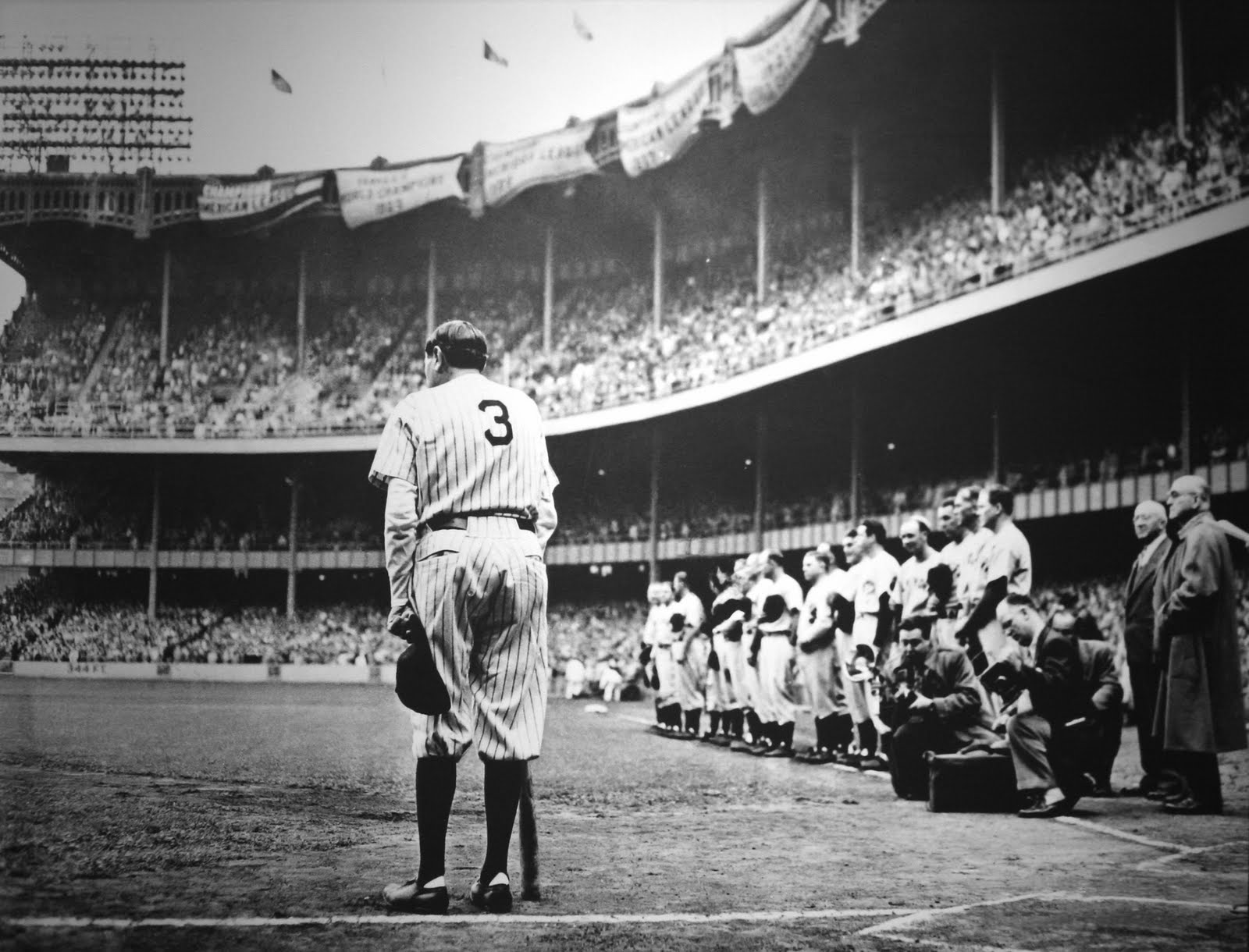
1) Babe Ruth

Like the other lists so far, the choice for #1 was extremely simple.  The Sultan of Swat.  The King of Crash.  The Titan of Terror.  The Colossus of Clout.  The Colossus of Clout.  The GREAT BAMBINO!

Babe Ruth.

Ruth is a legend, an athlete that transcends the sport he played in.  Michael Jordan and Muhammad Ali: those are his peers, not baseball players. But to get that way, he had to be pretty good at baseball too.

The legend of Ruth begins in Boston where he was a three-time World Series-winning pitcher for the Red Sox.  Ruth even still holds the World Series record for consecutive scoreless innings pitched.  First playing in 1914, Ruth saw more at-bats every year in the majors.  Even as a pitcher, his bat was invaluable.  It wasn’t until he was traded to the Yankees though—a move that seemingly crippled Boston for the next 86 years—that Ruth moved to the outfield full-time.

Before Ruth came along, the record for home runs in a season was 27.  After seeing a few more at-bats and leading the league with 11 home runs in 1918, Ruth blasted 29 in 1919.  Coming to the Yankees in 1920, he hit 54.  The following year he hit 59.  Then six years later, in 1927 Ruth jacked 60 long balls, a record that stood for the next 34 years.  Ruth revolutionized the game and ushered in the “live ball” era.  His flair for the long ball and his over-sized personality made everyone want to watch.

What everyone saw was the greatest baseball player of all-time.

The league-leader in home runs twelve times, Ruth’s 714 career home runs record stood for 39 years; that total still stands third all-time.  Ruth still holds the MLB career records for both slugging percentage (.690) and OPS (1.164).  Ruth’s .342 batting average ranks tenth all-time; he’s second on the all-time RBI list with 2,213; he has the 2nd-highest on-base percentage with a .474 mark; Ruth ranks fourth all-time in runs scored with 2,174; he’s sixth with 5,793 total bases; and his 2,062 walks rank third.

As a pitcher, Ruth posted a 2.28 ERA, which stands as 17th-best all-time.  With a 94-46 career record, Ruth also holds the 11th-best win-loss percentage, and he has the 13th-lowest home runs allowed per 9 innings ratio in history.

All told, Ruth won seven World Series (three with the Red Sox and four with the Yankees), one MVP award, was named to two All-Star Games, and was the biggest player baseball’s ever seen.

#1 Babe Ruth

--from @jeuneski